
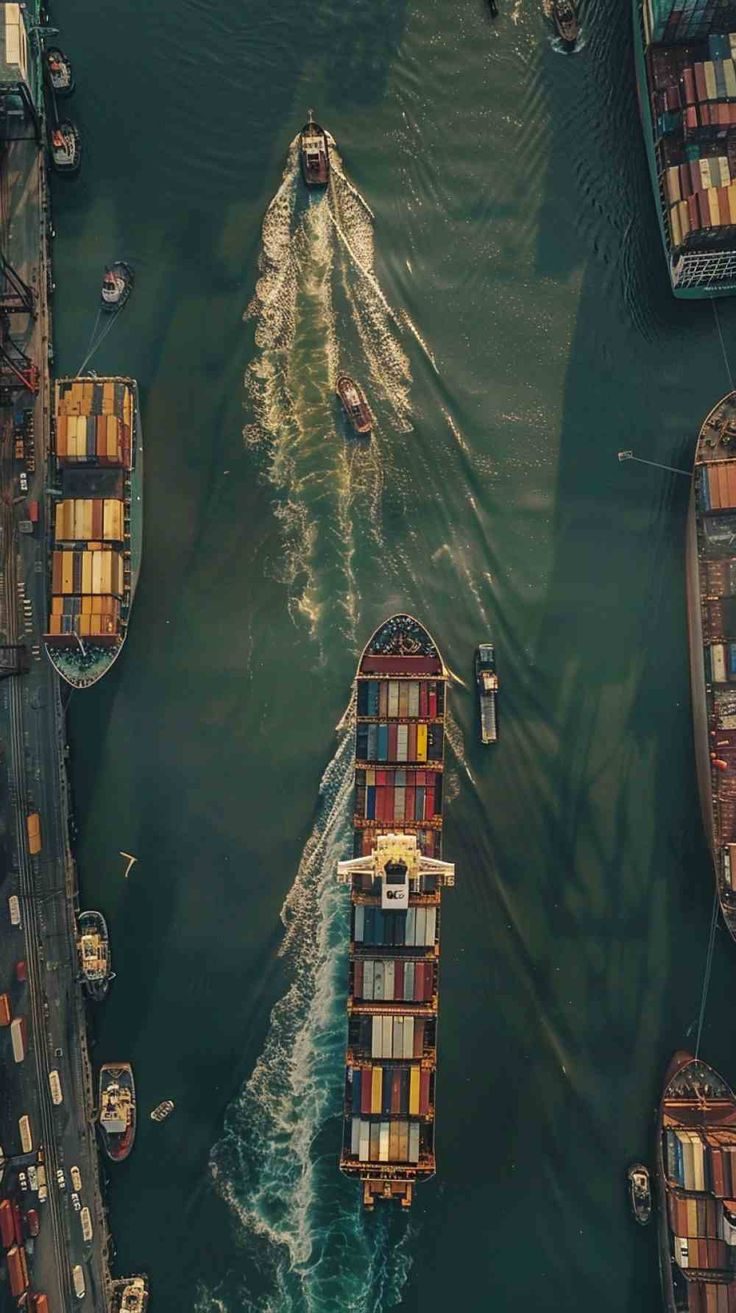
The standard
Before containerisation, general cargo was loaded piece by piece. A ship could spend as long in port as at sea, cargo was pilfered and damaged routinely, and the cost of moving manufactured goods internationally was high enough to shape what was worth trading at all.
The container changed that by making cargo a standard unit — one that a crane, a chassis, a railcar and a ship could all handle without knowing what was inside.
| Unit | Nominal length | Notes |
|---|---|---|
| TEU | 20 feet | Twenty-foot equivalent unit; the industry's counting unit |
| FEU | 40 feet | Two TEU; the most common box in service |
| High cube | 40 or 45 feet, taller | Additional volume for light cargo |
| Reefer | 20 or 40 feet, refrigerated | Requires power and monitoring |
| Tank container | Framed tank | Liquids in the container system |
| Open top / flat rack | Various | Out-of-gauge and project cargo |
Standardisation of dimensions and, critically, of corner castings and twistlock fittings is what allows a box loaded in one country to be handled anywhere. It is one of the most economically consequential standards ever agreed.
The system, not the box
Containerisation works because the whole chain adopted it:
Purpose-built ships with cell guides, terminals with ship-to-shore gantries, chassis and railcars sized to the box, and — increasingly — the documentation and data systems that track it. Take away any one and the economics collapse.
Where the system strains
Imbalance. Trade flows are not symmetrical, so empty containers must be repositioned. That is pure cost, and it is a permanent feature of the system.
Port capacity and congestion. The system is only as fast as its slowest terminal. Congestion propagates through schedules across whole trade lanes.
Schedule reliability. Xeneta data for December 2025 showed reliability on Far East–Mediterranean at 28.8% and Far East–North Europe at 27.5%, against 45.3% and 48.8% respectively in October 2023.
Routing disruption. Suez container transits ran at approximately 120 in November 2025 against 583 in October 2023, extending Far East–Europe transit times by 12–15 days.
Cargo declaration. Misdeclared dangerous goods remain one of the most serious safety risks in the segment. The box's greatest strength — nobody needs to know what is inside — is also its greatest hazard.
Weight verification. Verified gross mass requirements exist because incorrect container weights cause stow errors, stack failures and stability problems.
What it did to the world economy
Containerisation collapsed the transport cost component of manufactured goods, which in turn made it economic to distribute production across countries. Complex supply chains — components made in several countries and assembled in another — are only viable when moving a box is cheap and predictable.
That is also why disruption is so consequential. When transit times extend by two weeks, the working capital tied up in goods at sea rises across the entire system, and businesses that ran lean inventories discover why buffers existed.
reliability and transit data from Xeneta, December 2025 — refresh before publication. Cycle-time chart is an indicative model. Reviewed by the Zeaclub Editorial Team, 24 August 2026.
Frequently asked questions
What is a TEU?
Twenty-foot Equivalent Unit — the standard measure of container capacity. A 40-foot container is two TEU.
Why are containers standardised?
Because standard dimensions and corner fittings allow any crane, chassis, railcar or ship in the system to handle any box without adaptation. That interoperability is the entire economic value.
What is empty repositioning?
Moving empty containers from surplus regions to deficit regions because trade flows are unbalanced. It is a significant and unavoidable cost in the system.
Why do container ships catch fire?
Most seriously, because of misdeclared or improperly packed dangerous goods, and increasingly lithium-ion batteries. Fires in deep bays are extremely difficult to fight, which makes declaration accuracy a safety-critical control.